


 Cart
Cart
 sales@molnova.com


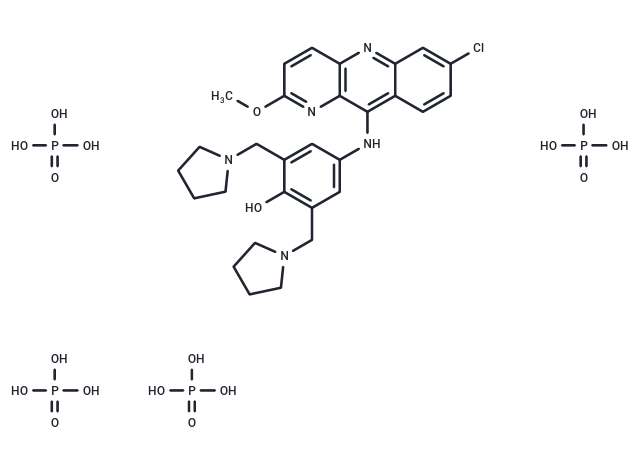
Pyronaridine tetraphosphate
CAS No. 76748-86-2
Pyronaridine tetraphosphate( —— )
Catalog No. M33472 CAS No. 76748-86-2
Pyronaridine tetraphosphate is an orally active, mannitol-containing inhibitor of DNA topoisomerase 2 and erythrocyte cytokine with antimalarial and antitumour activity.
Purity : >98% (HPLC)
 COA
Datasheet
HNMR
HPLC
MSDS
Handing Instructions
COA
Datasheet
HNMR
HPLC
MSDS
Handing Instructions
| Size | Price / USD | Stock | Quantity |
| 10MG | 28 | Get Quote |


|
| 500MG | Get Quote | Get Quote |
|
| 1G | Get Quote | Get Quote |
|
Biological Information
-
Product NamePyronaridine tetraphosphate
-
NoteResearch use only, not for human use.
-
Brief DescriptionPyronaridine tetraphosphate is an orally active, mannitol-containing inhibitor of DNA topoisomerase 2 and erythrocyte cytokine with antimalarial and antitumour activity.
-
DescriptionPyronaridine tetraphosphate is an orally active Mannich base anti-malarial agent. Pyronaridine tetraphosphate is active against P. falciparum and Echinococcus granulosus infection.
-
In VitroPyronaridine tetraphosphate (24 h) shows anti-P. falciparum activity with an IC50 value of 1.53-3.94 nM.Cell Viability Assay Cell Line:P. falciparum: 3D7, K1, VS1, FCB, TM90C2a, FCR3 Concentration:0-7 nM approximately Incubation Time:24 h Result:Exhibited anti-P. falciparum activity with Mean IC50 values of 2.31 nM, 3.94 nM, 1.63 nM, 1.53 nM, 2.51 nM, 2.21 nM repectively.
-
In VivoPyronaridine (57 mg/kg, oral administration, q.d. for 30 days) tetraphosphate reduces the parasitic burden in the Echinococcus granulosus-infected mice.Pyronaridine (57 mg/kg, intraperitoneal injection, q.d. for 3 days) tetraphosphate reduces the parasitic burden in secondarily infected (cysts) mice.Pyronaridine (57 mg/kg, intraperitoneal injection, for a single dose) tetraphosphate exhibits a higher exposure in the liver than in the plasma in male ICR mice.Animal Model:Echinococcus granulosus-infected mice model Dosage:57 mg/kg Administration:Oral administration, q.d. for 30 days Result:Reduced 42.4% of parasite wet weight and killed 90.7% of secondary infection (cysts) of E. granulosus ss.
-
Synonyms——
-
PathwayCell Cycle/DNA Damage
-
TargetTopoisomerase
-
RecptorTopoisomerase
-
Research Area——
-
Indication——
Chemical Information
-
CAS Number76748-86-2
-
Formula Weight910.03
-
Molecular FormulaC29H44ClN5O18P4
-
Purity>98% (HPLC)
-
SolubilityIn Vitro:?H2O : 25 mg/mL (27.47 mM; Ultrasonic (<60°C)) DMSO : 12.5 mg/mL (13.74 mM; Ultrasonic (<60°C)
-
SMILESO=P(O)(O)O.ClC(C=CC1=C2NC3=CC(CN4CCCC4)=C(O)C(CN5CCCC5)=C3)=CC1=NC6=C2N=C(OC)C=C6.O=P(O)(O)O.O=P(O)(O)O.O=P(O)(O)O
-
Chemical Name——
Shipping & Storage Information
-
Storage(-20℃)
-
ShippingWith Ice Pack
-
Stability≥ 2 years
Reference
1. Vivas L, et al. Anti-malarial efficacy of pyronaridine and artesunate in combination in vitro and in vivo. Acta Trop. 2008 Mar;105(3):222-8.?
molnova catalog



related products
-
Datopotamab deruxtec...
Datopotamab deruxtecan (DS-1062) is a trophoblast cell surface antigen 2 (TROP2)-targeted antibody-drug conjugate (ADC) with antitumor activity.
-
Simmitecan hydrochlo...
Simmitecan hydrochloride is a camptothecin derivative, a topoisomerase I inhibitor with anticancer activity, which can be used to study is solid tumors.
-
Cu(II)-Elesclomol
Cu(II)-Elesclomol is a complex formed by the anticancer agent Elesclomol and Cu(II), which selectively transports copper to mitochondria.Cu(II)-Elesclomol has anticancer activity, inhibits the growth of human leukemia K562 cells, and induces cell-cycle arrest, and is used in the study of leukemias.
